

Everyone says L2s are dead. Robinhood just launched one!
Three chains carry 99.7% of L2 traffic and the rest are corpses. Robinhood shipped one anyway, and the playbook it's running is the one I watched win from the inside.

Robinhood launched its own blockchain today, which in crypto is the most discredited business move of the last two years.
For a while I had one of the stranger jobs in the industry: growing an ecosystem on the one chain of this kind that decisively won. So when the biggest retail brokerage in America ships a blockchain into what everyone now calls a graveyard, I want to know whether it’s late to a dead trend or has read the ending better than the obituary writers.
First, a translation for readers who don’t live in this world. Ethereum is the settlement network most of crypto builds on, and using it directly is like wiring money through the central bank: secure, but slow at rush hour and the fees sting. A layer 2, an L2, is an express lane built on top. It processes transactions fast and cheap, then posts compressed receipts back down to Ethereum, so it borrows Ethereum’s security without its congestion. And owning one is owning a toll road: whoever runs the chain collects a fee on everything that crosses it. That’s why, for two years, everybody launched one. It’s also why the crash that followed was so ugly.
Here’s what Robinhood shipped, live on July 1, after a testnet that has processed nearly 200 million transactions since February, their number:
The chain itself. Built on Arbitrum‘s stack with 100 millisecond block times, unveiled at Greenwich under the banner “The World is Flat.”
Stock Tokens, trading 24/7 in more than 120 countries through Robinhood Wallet.
Robinhood Earn, paying an estimated 7% on idle dollars through Morpho, with exploit insurance from Lloyd’s of London and RELM (a policy that covers Robinhood, not depositors).
Trading venues: perps through Lighter, a dedicated Uniswap exchange, and Arcus, a new venue from the dYdX team.
Free gas for the first 90 days on swaps, stock-token trades, and bridging in.
HOOD rallied to its highest level since mid-June.
How dead are L2s, actually
I pulled the transaction counts myself instead of quoting anyone’s deck. Here is the last 7 days across the major Ethereum L2s (my Dune query, run July 1):
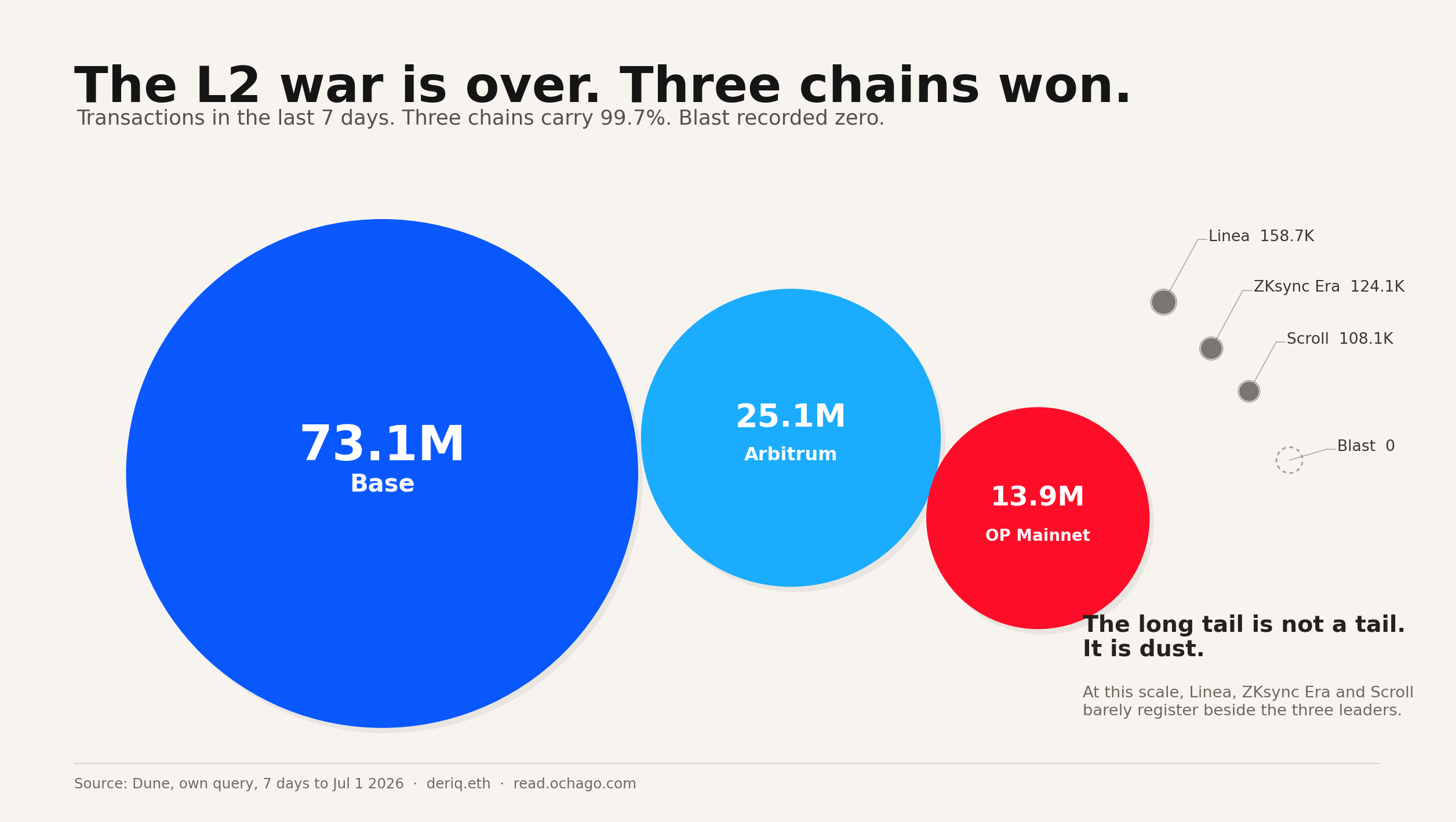
Base did 73.1 million transactions. Arbitrum did 25.1 million, OP Mainnet 13.9 million. Then the cliff: Linea did 159 thousand, ZKsync Era 124 thousand, Scroll 108 thousand. Blast, a chain that held over a billion dollars at its 2024 peak, recorded zero. The top three carry 99.7% of everything in that sample, and Base processes Linea’s entire week in about 22 minutes.
The culling behind those numbers has been running all year: Kinto shut down, Loopring closed its wallet, Blast collapsed 97% from peak before flatlining. And in February the architect disowned the blueprint. Vitalik Buterin wrote that Ethereum’s rollup-centric roadmap “no longer makes sense”: L2s decentralized far slower than expected while Ethereum’s own base layer got faster and cheaper, and any L2 that wants to exist should “identify a value add other than scaling.”
So the thing that died deserves a precise name. It was never “L2s.” It was the thousand-chain thesis, the idea that launching a toll road was itself a business. The roads were nearly identical. The traffic never was, and the traffic belonged to whoever already had the users.
Why Robinhood launched into a graveyard
Robinhood knows exactly where it’s launching. Its crypto chief, Johann Kerbrat, said the quiet part on his own stage:
“Let’s be honest, this is nothing to write home about. Every day there’s a new chain being launched. So it’s not special because we did it. It’s special because of what this chain now makes possible.”
He’s right, and I watched the proof from the inside, running ecosystem growth for Base, so this is the part I can say with some authority: Base didn’t win on technology. Base won because Coinbase stood behind it and poured millions of verified, funded customers down the funnel. Every chain in the graveyard had blockspace. One chain had an exchange.
Robinhood Chain is that playbook run by a brokerage. Robinhood did to Arbitrum what Coinbase did to Optimism: picked a partner’s technology, kept the customer relationship, and made the chain an extension of its own app, aimed at stocks instead of everything. It brings 28 million customers and exactly what vitalik.eth obituary demanded: a value add other than scaling. The docs read like a brokerage that means it, permissionless deployment, ETH for gas, first-come-first-served sequencing so bots can’t pay to jump the queue, and a pitch aimed at AI agents that trade and lend.
Now put Wednesday next to the week’s other two standards stories. On Monday, 140 companies launched Open USD, the committee dollar I wrote about. On Tuesday, MiCA handed Europe’s dollar market to whoever holds a license. And notice two names missing from Monday’s guest list: Robinhood and Arbitrum. A coalition that fit 140 logos on one page couldn’t locate the brokerage with 28 million customers or the second-busiest L2 on earth. They weren’t hard to find. Robinhood co-founded its own consortium, the Global Dollar Network, with Paxos, Kraken, and Galaxy in November 2024, sharing reserve yield with distributors two years before this week made it sound novel. Earn pays its 7% in USDG, the GDN dollar. Three answers to who-controls-the-standard in 48 hours: a committee, a regulator, and a company that skipped the negotiation and built the whole stack.

What this means if you’re not in crypto
The sharpest explanation came from Robinhood’s own stage. For the flagship demo, the company went 3,100 miles straight down the prime meridian, Greenwich to Ghana, to a man named Abu who works with an education fund in cocoa-farming communities. Kerbrat sent him a SpaceX stock token, live. His framing: sending stock across most borders takes “two to four weeks minimum and so much paperwork and bureaucracy it’s almost not worth it”. On the chain it took seconds, phone to phone, no broker in between.
What Abu holds tracks the SpaceX share price; it isn’t the share itself, and the difference matters. Last year’s tokens were derivative contracts with Robinhood’s European entity; your real risk was Robinhood itself. The new ones are rebuilt: still backed one-for-one by real shares, and structured, Robinhood says, so that “your interest is secured no matter what happens to Robinhood,” with institutions eventually able to redeem tokens for the underlying shares. The redemption is planned, not live, and the secured-interest claim will get the scrutiny it deserves. No version carries a vote at the shareholder meeting, and that’s regulation, not stinginess: pass through ownership and voting and the token becomes an equity offering needing registration in every one of those 120 countries; wrap it as an instrument that tracks the price, and it can travel. So Abu gets the part of a stock that compounds and pays, dividends arrive as cash, and gives up the part retail almost never uses. When did you last vote a proxy? I wrote in May about Nathan Allman, who built Ondo’s tokenized brokerage for exactly this person. Six weeks after his death, a 28-million-customer brokerage staged its launch demo around him.

What I’m watching
Six things, written down so I can’t wriggle out later.
Where the float lives on day 91. Gas is free until roughly the end of September, and subsidized activity always looks like adoption. If Stock Token supply and holders keep climbing in October, the demand is real. If the charts plateau when the free gas ends, this was a launch, not a market.
The rematch with Base. My old chain versus the new one running its playbook. Tokenized equities are building on Base too: Dinari brought its 1:1-backed dShares there, while Coinbase fights the Washington fight over the rules. The entire on-chain tokenized-stock market held about $1 billion in late June. Robinhood’s distribution could dwarf that in a quarter, or Base’s head start in builders could hold.
Whether the corporate chain becomes the standard. Forbes groups Robinhood Chain with Base and Stripe’s Tempo as corporate chains pulling value from neutral ecosystems; Kraken’s Ink is a year old. The candidate I’m watching is eToro: Yoni Assia said last summer the brokerage was talking to “four or five” ecosystems about a dedicated chain, because “we’ll need, by definition, to have a dedicated blockchain if we want to run the entire eToro ecosystem.” If eToro or any similar player announces within the year, the corporate L2 is the category that replaced the thousand rollups. If nobody follows, Robinhood is an outlier, not a standard.
What gets built there. The docs say anyone can deploy. The first serious third-party app on Robinhood Chain that Robinhood didn’t build will tell you whether this is an ecosystem or a very nice private rail.
Who shows up at the standards table. Watch whether Robinhood or Arbitrum ever appear on Open Standard’s member list. I doubt it, and the reason is in my own numbers: USDG, the dollar Robinhood co-founded and now calls “our native dollar,” sits at $2.93 billion, up 50% in a quarter, holders up from 61,600 to 90,800. Kerbrat put it at “almost $3 billion” on stage; my query agrees. That’s nearly twice Ripple’s RLUSD, and almost nobody writes about it. Robinhood doesn’t need a seat at Stripe’s table. It has its own.
The US door. The strangest fact of the week is that America’s most famous retail brokerage excluded America from its flagship product. That’s a regulatory posture, not a preference. The day US rules allow tokenized equities at retail, this stops being an export product and becomes the main one.
The question I started with, whether L2s are dead, turns out to be the wrong question, and Robinhood just made the right one unavoidable. Chains stopped being businesses somewhere in this year’s culling. Distribution never stopped. The graveyard is full of teams that built toll roads and waited for traffic, and the survivors are companies that had the traffic and paved a road under it. Robinhood launched this chain the way it once launched options and gold cards: one more surface for 28 million customers it already owns. The chain was never the business. The customer list is.
I hold no position in HOOD, ARB, MORPHO, or any token named here. Transaction counts and USDG supply are my own Dune queries (7861420, 7861422), run July 1; event quotes are from Robinhood's livestream. One operator who ran the winning version of this playbook, reading the next company to try it. Not investment advice.