

Live commerce already runs Africa every night. Nobody owns the checkout.
A market nobody has measured, and TikTok Shop has not arrived to claim it.

It is 9pm in Nairobi. In a corner of Gikomba market, a mitumba trader points her phone at a heap of secondhand jackets and goes live on TikTok. A few hundred people are watching. She holds one up, someone comments “mine,” and it is theirs. The money lands in her M-Pesa a minute later, sent in a DM. Tomorrow the jacket moves across the city on a boda, or up-country on a bus, collected at the stage (Business Daily).
Same hour, Lagos. A menswear seller streams to about two hundred viewers, takes bids in the comments, and when a price is agreed the buyer transfers to the bank account on screen and follows up with a DM to confirm (TechCabal). One vendor told a reporter she made 500,000 naira in three nights.
This is live commerce, and it is already one of the largest things happening in African retail. It just runs on borrowed rails, TikTok Live and Instagram and WhatsApp, none of which were built to sell anything. What is missing is the part that turns a livestream into a business: a trusted checkout. Escrow. Buyer protection. Seller payouts. A way to pay a stranger two cities over and know your money is safe. Nobody owns that layer. And the company best placed to own it, TikTok Shop, has not launched anywhere on the continent. Not Nigeria, not Kenya, not even South Africa, its most ecommerce-ready market, where TikTok’s own help pages say the shop is “not publicly available” (TikTok). The land is empty.
The wedge is trust
Every one of those sales is a prepayment leap of faith. You pay first, then you hope.
The market knows it. In Kenya, roughly one in five products sold is counterfeit (Techweez), and fake shops regularly flood TikTok cloning real retailers. In Nigeria, an EFCC analysis found fake social-media businesses are a leading fraud category, with Instagram vendors out front (Business Elites Africa). In South Africa, 77% of adults were hit by a scam in the year to early 2025, and courier and delivery fraud is the single most common type (Dark Reading). In Ghana the cyber authority logged losses that nearly doubled year on year, with WhatsApp and Instagram near the top of the list (JBKlutse).
The tell is the incumbents themselves. Jiji, the largest classifieds platform on the continent, tells buyers not to pay in advance and to meet sellers in person to inspect goods (TechCabal). Its safety page is an admission: there is no trusted layer, so good luck. Escrowed checkout with buyer protection is the product here, not a bolt-on feature.
The hard question, asked first: does it actually work?
A serious operator’s first objection should be India, where almost every standalone live-commerce startup died. YouTube shut Simsim two years after acquiring it; Bulbul wound down. The failure mode was the same each time: tiny baskets plus expensive fulfillment, which is negative unit economics on every order. Africa carries that low-basket risk too. So three things have to be true, and I have watched all three up close over a decade of doing market entry here.
Payments are nearly free where the buyers already are. M-Pesa’s Buy Goods costs the merchant about 0.5%, and reaches 82% of Kenyan adults (Safaricom FY25). Ghana’s MTN MoMo charges merchants 0.75% up to a cap (MomoCalc). Nigeria’s Paystack is roughly 1.5%, capped per transaction (Paystack). Card acquiring elsewhere runs 2.5% to 3.5%. The payment rail that strangled most Africa pitches is the one problem already solved.
Sellers already batch. A mitumba seller moves twenty to fifty items in a stream, so the basket per delivery is a multiple of the single-item order that killed India’s players. The behavior that makes the economics work is here before anyone builds a thing.
Last-mile is cheap and dense where the buyers cluster. Same-day boda inside Nairobi runs a dollar fifty to four dollars; an intercity bus parcel, collected at the stage, a little more.
Now the honest half, because this is where the boosters go quiet. The African graveyard is real and it teaches exactly one lesson. Copia raised about $123 million and went into administration in 2024, killed by sub-$5 rural baskets and the cost of failed deliveries. Sendy wound down. Sky.Garden nearly collapsed. Jumia has lost on the order of $2.1 billion since founding. Every one of them died the same death: they owned and subsidized fulfillment against thin baskets. The survivors will own the trusted checkout, not the trucks. In this market you are asset-light or you are dead.
One pattern, four textures
The mechanic is identical everywhere, stream and claim and pay and ship. The execution is local, and the differences are the whole game.
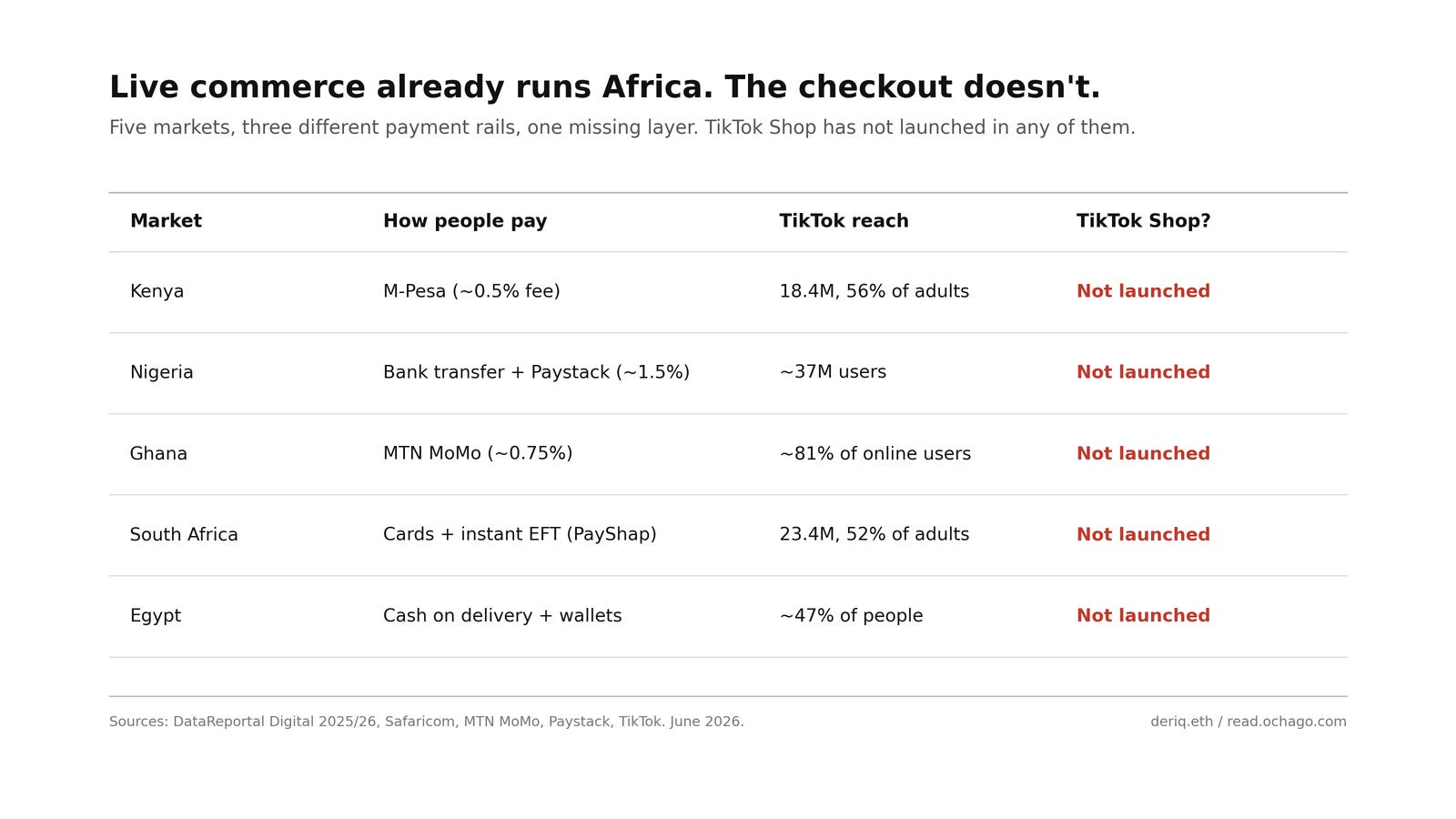
Kenya is the cleanest entry. Mobile-money-native, English-speaking, and the live-selling is already proven: 18.4 million Kenyans are on TikTok, 56% of all adults, nearly five times Instagram’s reach (DataReportal). The rails, the language, and the behavior all line up.
Nigeria is the biggest and the messiest, and the rail is different. This is the trap for anyone who learned the continent in Nairobi: Nigeria does not run on a telco wallet. It runs on bank transfers and fintech, Paystack and OPay and the bank apps, which is why the on-screen checkout is “send to this account number.” Addressing is more broken, fraud is at industrial scale, and a local startup, Auqli, is already building the exact missing layer, a naira-native in-stream checkout (Auqli). Whoever enters Nigeria is not first.
Ghana is the clean small cousin. MTN MoMo-led like Kenya, internet penetration around 75%, but one-seventh Nigeria’s size, and the live-selling behavior is thinner in the public record than Kenya’s or Nigeria’s. Strong rails, smaller prize, less proof on the ground.
South Africa is the outlier, and it matters most for timing. It runs on cards and instant bank transfer, not mobile money; PayShap was clearing tens of millions of transactions a month by late 2025 (TechCabal). And alone on the continent, it has real street addresses and dense pickup-and-locker networks. It is the closest thing to a developed market, with an African-scale fraud problem on top. It is also the market everyone assumes TikTok Shop already runs in. It does not.
Egypt is a fifth shape entirely, cash-on-delivery, Arabic, MENA-facing, with the Gulf next door already on TikTok Shop, which tells you the platform is circling the region.
The diaspora is the part that makes it continental
The Nairobi seller I opened with already has buyers in London and New York. A real one, Esther Kwamboka, put it plainly to a reporter: “I have clients in Nairobi, Kisii, Nanyuki, Nyeri, even the US and UK. I’ve shipped through DHL.” Africans abroad are the biggest buyers of clothes leaving the continent (Quartz Africa), and the US-to-Nigeria remittance corridor alone is roughly $21 billion a year (World Bank). The cross-border demand is real and it is happening today, over DHL and WhatsApp groups and someone flying home next month. The trusted layer for it does not exist. That is the same gap, one degree harder.
The clock, and who is positioned
TikTok Shop is the obvious eventual winner, and that is precisely why the window is finite. Globally it roughly doubled, from around $33 billion to $64 billion in GMV in a single year (Momentum Works), and did about $45 billion in Southeast Asia alone. When Indonesia banned social-commerce in 2023, TikTok simply bought 75% of Tokopedia for about $1.5 billion and kept going. It will come to Africa. The only question is when, and what is already built when it does.
Whatnot is the better fit for how this market actually behaves. The US live-shopping platform did more than $8 billion in GMV in 2025 and is valued at $11.5 billion (cllct), and its model is live video plus trusted checkout plus buyer protection plus automatic payouts, run market by market with a local general manager and no trucks of its own. That asset-light shape is the one the graveyard rewards. It has committed nothing to Africa. Jumia has the assets and the presence, and also the $2.1 billion of losses and the fulfillment-heavy DNA that this market punishes. The opening is for whoever supplies trust and checkout without owning the fulfillment, and does it before TikTok’s blockers clear.
What the prize actually is
Let me be precise about the size, because the boosters will not be. Kenya’s entire formal ecommerce market is about $2.3 billion, a rounding error against any global platform’s numbers. This is not a near-term revenue needle-mover, and anyone who hands you an informal live-commerce GMV figure is making it up, because nobody has measured it. That absence is the entire point. The prize is formalizing a visibly enormous, completely uncounted informal economy and owning the beachhead for a continent that is young, mobile-first, and already live-selling every single night, not capturing the small formal market that exists today.
The window is real. It is not infinite. Somebody is going to own the checkout. Right now, nobody does.
Great read
This was a fabulous read. Thank you for the research you put into it. Live stream market bidding would be great for shoe sellers in Uganda selling to the diaspora as well because the number of times I'm buying bootleg sneakers here to send over with someone coming who knows someone who wants a pair. (Rambling)
Having a payment system that adds a layer of security removes headaches on both sides of the con/purchase. The Instagram/TikkieTokie shops selling clothes would make a buck since whenever they get new stock, it's straight to the stories. And the way those items fly off and get sold. Same with beddings.
I've seen the Asians do the live stream e-commerce and how well and feasible and entertaining it was. Would be nice to see it grow here.