

Hard Fork Africa: Are We Sleepwalking into a New Digital Colonialism?
As AI reshapes our world, we must ask: who benefits, who decides, and who might be left behind?

I've been thinking deeply about artificial intelligence lately, particularly its impact beyond Silicon Valley and the Global North. While headlines trumpet each breakthrough in large language models and marvel at new capabilities in medical diagnosis and coding, a more complex story is unfolding across the African continent.
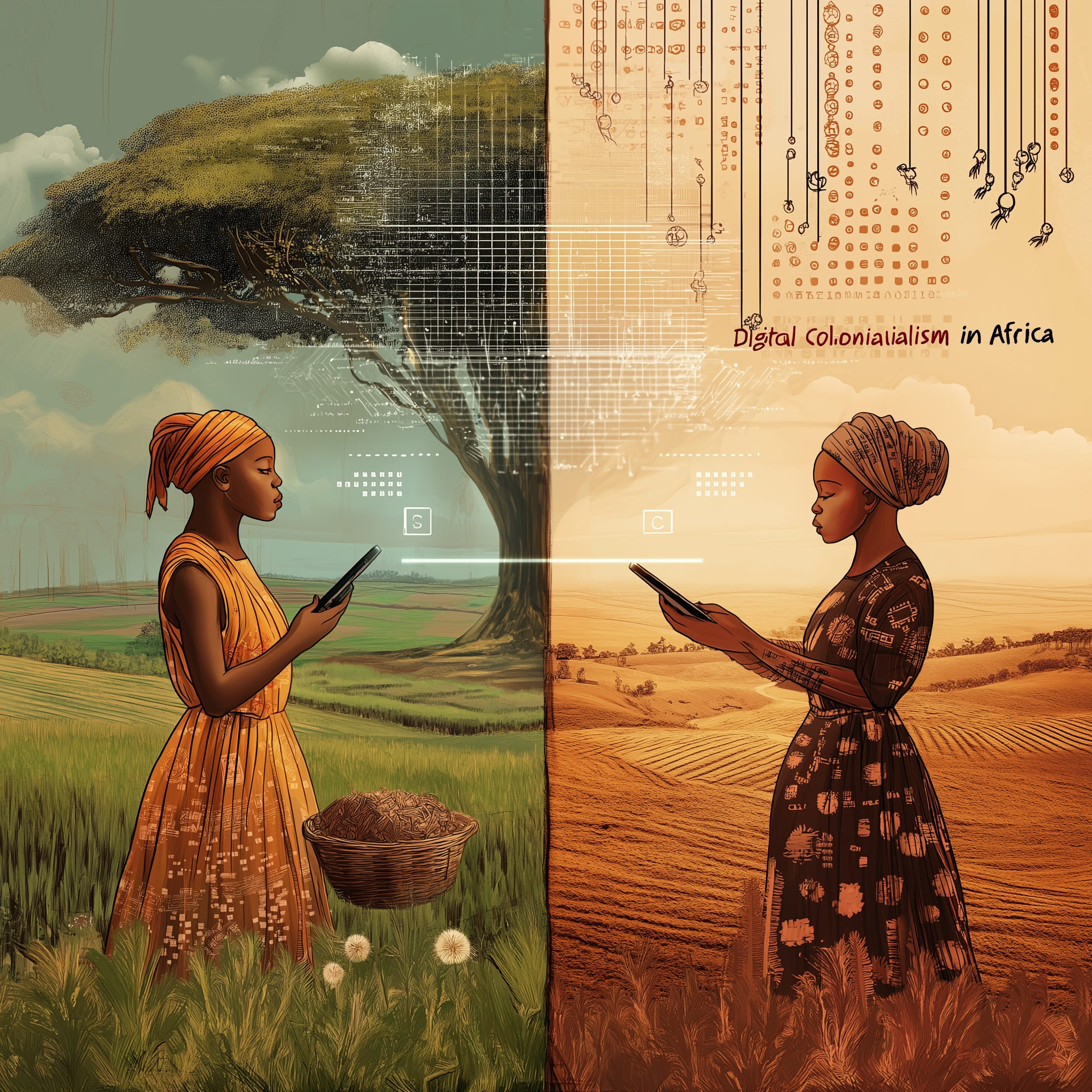
The Promise and the Peril
Picture this scenario:
A tech company unveils an AI-powered agricultural tool promising revolutionary improvements for smallholder farmers across rural Africa. The press release highlights potential yield increases of 30%, reduced water usage, and optimized harvesting schedules. Western investors applaud. Development organizations celebrate.
But there's a problem.
The AI model was trained primarily on data from industrial American farms. It doesn't account for the diverse microclimates across African regions. It hasn't incorporated knowledge from generations of traditional farming practices. And crucially, it requires expensive sensors and reliable internet connectivity that many communities simply don't have.
This isn't just a hypothetical. It represents a pattern emerging as AI technologies developed in Silicon Valley, Beijing, and other tech hubs are deployed across Africa with insufficient consideration for local contexts and needs.
Digital Colonialism: History Rhymes
Historical colonialism extracted natural resources and imposed external governance systems. Today's emerging "digital colonialism" follows disturbingly similar patterns:
Data Extraction: African data harvested and utilized by global tech giants with minimal local benefit or control
Technological Dependency: Africa positioned as a consumer rather than co-creator of AI systems
Cultural Imposition: Western-centric ethical frameworks and values embedded in AI design without incorporating African perspectives
Economic Subordination: Benefits of AI deployment disproportionately accruing to global technology companies, widening existing digital divides
The concept of digital colonialism, as outlined in 'AI in Africa: Avoiding Digital Colonialism', describes an extractive relationship where African data and digital infrastructure are being utilized by global entities in a way that mirrors historical colonial patterns of resource extraction.
The Governance Gap
The regulatory landscape for AI across Africa presents another challenge. While the EU finalizes its comprehensive AI Act and the US develops its approach, many African nations lack specific AI governance frameworks.
This creates a dangerous vacuum where:
Privacy protections may be insufficient for citizens whose data feeds AI systems
Accountability mechanisms remain unclear when AI systems cause harm
Economic policies aren't prepared for potential workforce disruptions
Cross-border data flows occur without adequate oversight
Moreover, the concept of "trustworthy AI" itself differs significantly across cultures. Western frameworks may emphasize individual autonomy and transparency, while many African societies place greater value on communal harmony and interconnectedness.
The philosophy of Ubuntu—emphasizing that "I am because we are"—offers a fundamentally different lens through which to evaluate AI governance than Silicon Valley's techno-libertarian ethos or China's state-centric approach.
Beyond the Binary
This isn't a simple story of technological determinism or digital doom. Africa's engagement with AI presents genuine opportunities alongside these risks:
AI-powered healthcare diagnostics could extend medical expertise to underserved regions
Natural language processing could preserve and revitalize indigenous languages
Predictive analytics could strengthen climate resilience for vulnerable communities
New digital industries could create meaningful employment opportunities
Visionary African technologists and policymakers are working to realize these possibilities. Figures like Abigail Oppong, Elnathan Tiokou, and Kutoma Wakunuma are actively shaping an Africa-centered approach to AI development and governance.
Forking the Future
The path forward requires a fundamental shift—a "hard fork" in how we conceptualize AI's global development:
Inclusive Design: AI systems developed with, not merely for, African communities
Data Sovereignty: African nations establishing clear frameworks for how their citizens' data is collected, used, and governed
Local Capacity: Substantial investment in African AI research, education, and entrepreneurship
Cultural Context: Ethical frameworks that incorporate African philosophical traditions and values
Equitable Distribution: Policies ensuring AI's benefits are shared broadly across society
The Questions We Must Ask
As we stand at this critical juncture, we need to critically examine:
Are we building truly global AI ecosystems or creating new forms of digital dependence?
How can we ensure AI development incorporates diverse African perspectives?
What governance structures would best protect citizens while enabling innovation?
How might AI deployment address rather than exacerbate existing inequalities?
These questions demand urgent attention—not just from African stakeholders but from anyone concerned with building a technological future that is just, equitable, and truly human-centered.
The current trajectory isn't inevitable. We can choose a different path. But that requires acknowledging the risks of digital colonialism and consciously working to create alternatives that center African agency, knowledge, and needs.
What are your thoughts? Have you observed AI deployment in African contexts that either reinforces or challenges these patterns? I'd love to hear your perspectives in the comments.
If you found this analysis valuable, consider sharing it with others concerned about AI's global impact. For deeper exploration of these themes, subscribe to receive future dispatches on technology's complex relationship with society, power, and justice.