

cNGN went from ₦105 million to ₦2 billion in a year. Now they're hiring growth.
Supply jumped over 1,800% in twelve months, but the real story of Nigeria's first regulated stablecoin is hiding in the distribution bottlenecks.

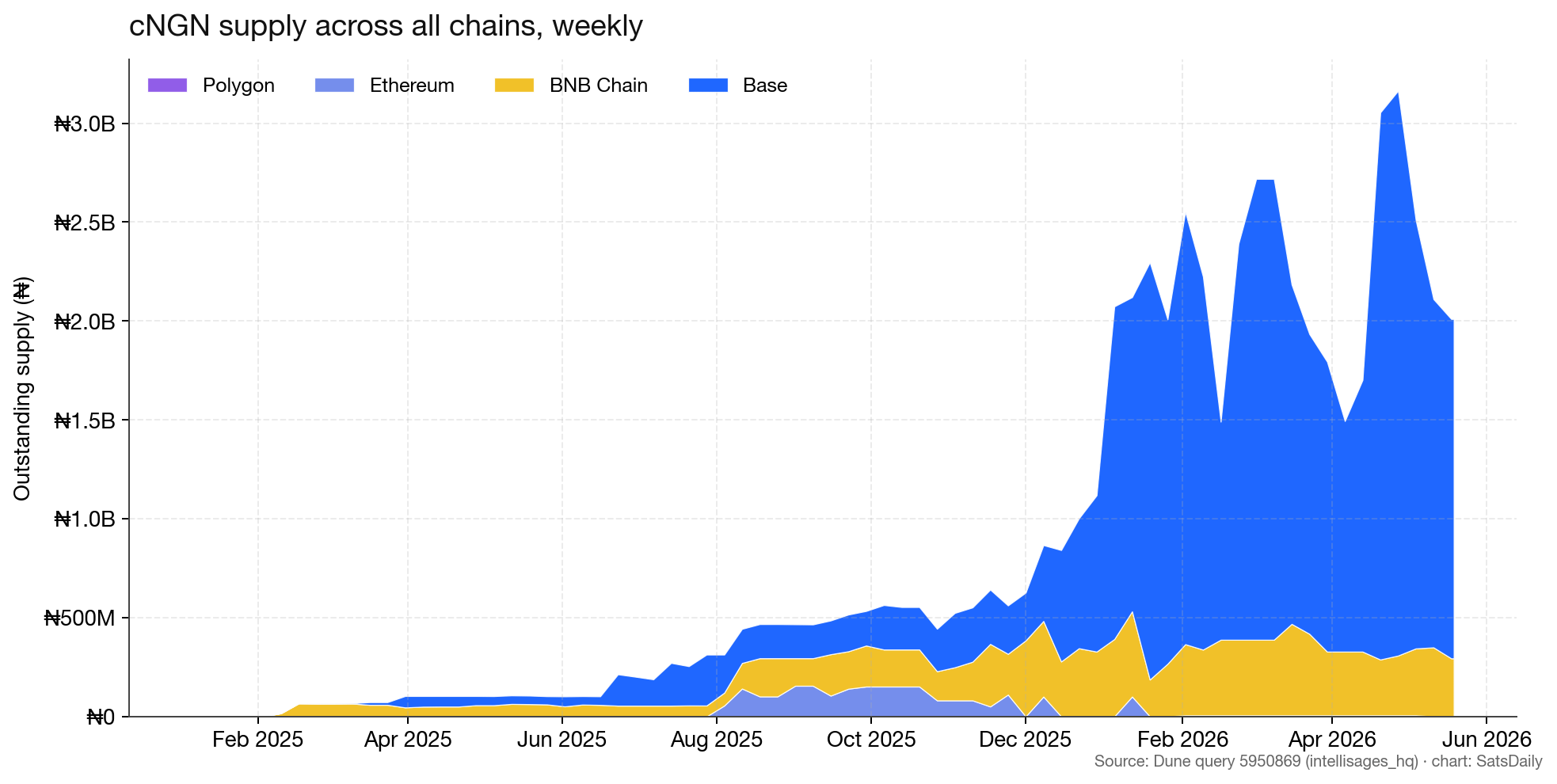
cNGN‘s outstanding supply grew 1,809 percent in the past twelve months, from ₦105 million to ₦2 billion.
That’s not a press-release number. It’s what the on-chain transfer logs say, weekly, across every chain cNGN lives on. I’ve been watching this curve for a while because Nigeria’s first regulated stablecoin is the one I want to see win, and I think there’s a real opening here. The data tells a more interesting story than the headlines do, and the part I’d be most worried about if I were running growth at cNGN isn’t on the chart at all.
What cNGN actually is
cNGN is a naira-pegged stablecoin. It went live on Nigerian exchanges in February 2025, after about three years of regulatory development. It sits 1:1 against the naira, backed by naira deposits at consortium banks.
Convexity built it. The Abuja-based blockchain firm, founded by Adedeji Owonibi, leads the Africa Stablecoin Consortium alongside Alpha Geek Technologies, Digital Currency Coalition, and Interstellar, plus a group of Nigerian banks and payment service providers.
WrappedCBDC Ltd is the legal vehicle. It holds the Nigerian SEC Accelerated Regulatory Incubation Program license, manages the naira reserves, and does the hiring.
The regulatory anchor is the part most people gloss over. cNGN sits in the SEC’s ARIP sandbox cohort alongside Quidax and Busha, the two licensed Nigerian exchanges, plus Trovotech, HousingExchange, and Dream City Capital (digital asset offering platforms) and Blockvault (the custodian). It’s a coalition that, if it works, looks more like a regulated capital markets stack for Nigeria than a single-token launch.
It currently lives on five chains: Bantu Blockchain (the consortium’s primary supply ledger), Base, BNB Chain, Ethereum, and Polygon.
What the data is telling me
Supply went from ₦105.3 million in May 2025 to ₦2.01 billion in May 2026. That’s a 1,809 percent jump. The peak during the year was ₦3.16 billion in late April 2026 before a sharp contraction. The chain split today: Base holds 85.4 percent, BNB Chain holds 14.6 percent, Ethereum is at 0.01 percent, Polygon at 0.001 percent.
The interesting beat sits in June 2025. Total supply doubled that month, from ₦97 million to ₦201 million. But the whole delta came from Base, which grew from ₦47 million to ₦146 million, more than 3x. BNB barely moved. That’s the moment Base overtook BNB on supply and never gave the lead back. The curve in the chart bends right around there.
One quieter signal from the same window. The growth didn’t pile into a single contract. If a yield product had been driving the inflows, the on-chain footprint would have concentrated. Instead it spread across many wallets. Whatever made June happen, it was retail or B2B onboarding, not yield hunting.
The supply volatility through 2026 is the other tell. Going from ₦3.16 billion peak in April to ₦2.01 billion six weeks later is a 36 percent contraction. Stablecoin supply doesn’t move like that unless a small set of large holders are minting and redeeming on cycles.
The holder data confirms it. Sixteen whale wallets hold 92.3 percent of all cNGN supply (ten on Base, six on BNB). The full breakdown today:
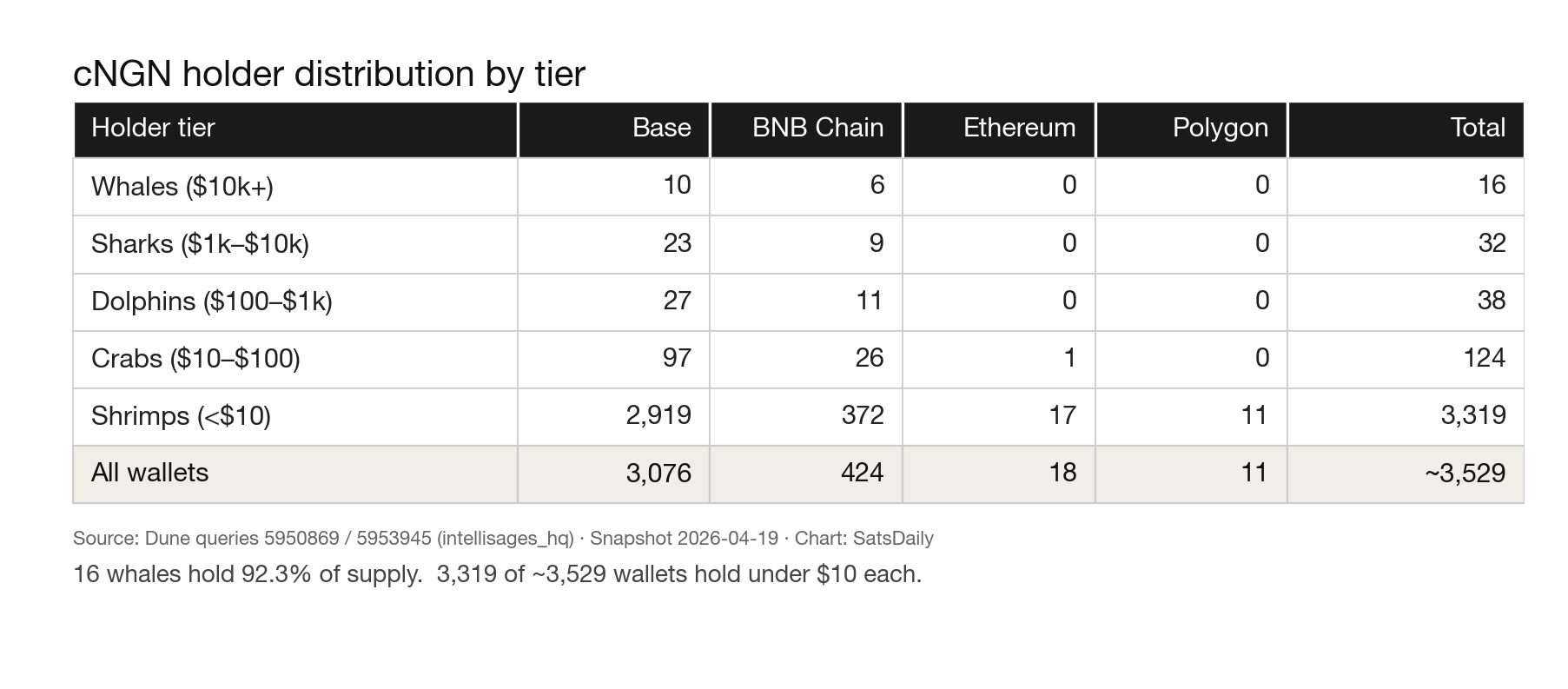
The bottom row matters more than it looks at first glance. Most stablecoin write-ups would dismiss the 3,319 wallets in the “shrimps” tier as dust or airdrop recipients. In Nigeria, the math reads differently. Median monthly income is around ₦100,000, the naira sits at roughly ₦1,500 to the dollar, and retail crypto users routinely hold and trade in small fractions of a dollar because that’s what disposable income allows. Three thousand wallets holding ₦5,000 to ₦15,000 of cNGN each could be exactly what early retail adoption of a naira stablecoin looks like, not dust.
If that read holds, the story isn’t 3,319 dust accounts sitting under 16 whales. It’s a thin but real retail base growing underneath a top-heavy treasury layer. The wallet count went from Plasma’s reported 832 in August 2025 to about 3,500 today. That’s a 4x jump in nine months, almost all of it in the small-holder tiers. Distribution is still the bottleneck because the supply is locked up in 16 wallets. But the curve underneath them is doing the right thing.
Where it’s hitting friction
Three real problems show up when you look past the growth chart.
Yield exists, but it lives off-chain. Xend Finance takes cNGN deposits and routes them into Nigerian short-dated government debt; the interest comes back to the holder in cNGN. Reported APRs land around 20.25 percent, which is roughly where Nigerian T-bill rates have been sitting. Real return, but it’s regulated money-market yield wearing a stablecoin skin, not DeFi yield. There’s no Aave, Compound, or Moonwell pool for cNGN on Base or anywhere else. If you’re a builder asking can I just plug cNGN into my lending app, the answer today is no.
The exchange landscape is softer than the press cycle suggests. Yellow Card and Roqqu, two of the biggest Nigerian-facing exchanges, have not listed cNGN. Yellow Card’s stance has been about reserve attestation gaps and capitalization thresholds; Roqqu’s is the chicken-and-egg complaint that there isn’t enough order flow on the asset yet to justify the listing. Both positions are circular: without listings, demand stays soft, and without demand, reserves don’t scale, and without scaled reserves, listings stay deferred. Busha and Quidax are in, but they’re not the volume leaders in this market.
Reserve attestation is the related credibility gap. The criticism around the project since launch has flagged that there isn’t continuous, public proof of reserves. This doesn’t have to become a Tether-style fight to be a problem. Until somebody can point to a monthly attestation, the “trust the bank deposits” argument is a brand argument, not a verifiable one.
The structural challenge underneath all three: cNGN is competing with Nigerian instant bank transfers (NIP / NIBSS rails) that are already cheap, fast, and ubiquitous for retail. A naira stablecoin’s user-grade speed advantage over NIP is near zero. The wedge has to come from programmability, regulator clarity, and B2B settlement. Not from outrunning the banks at their own game.
The growth role
A few days ago, WrappedCBDC closed applications for a Growth and Expansion Manager role for cNGN. Abuja-based with partial remote, reporting through Convexity’s founding team. Whoever takes that seat is walking into the holder distribution above.
Reading the on-chain data, here’s what should be on their desk in week one.
First, distribution into consumer apps. The four main Nigerian crypto apps are Busha (already lists cNGN), Bitnob, Yellow Card, and Quidax. Get cNGN integrated as a native asset on the three that haven’t. After that, push for Opay, PalmPay, or Kuda. A send naira to friend in cNGN feature inside one of those would 10x the wallet count in a quarter.
Second, diaspora corridors. Nigerian diaspora remittances run around $20 billion a year. If even a single-digit percent of that lands on cNGN rails on the receive side, the wallet count chart looks completely different in twelve months. Dollar stables don’t have a clean 1:1 naira leg without an off-ramp; cNGN does, structurally. The play is partnering with the cross-border players (LemFi, Lemonade Finance, Nala, Yellow Card) to put cNGN on the receive side of corridors out of the UK, US, and Canada.
Third, pick a B2B use case that isn’t trading. Stablecoin adoption in Africa runs through payroll, contractor payouts, and B2B settlement. Get one mid-sized Nigerian SaaS company paying 50 contractors in cNGN every Friday. That’s worth more than ten DEX listings. The economics already work because the company holds naira at a Nigerian bank, and cNGN is the programmable, cheaper version of what they were doing anyway.
Fourth, get DeFi-native yield onto Base. Xend’s money-market product is a treasury-bill wrapper. Useful, but it doesn’t deliver any of the composability that makes a stablecoin sticky in DeFi. A Moonwell cNGN market on Base or a Curve pool changes the builder pitch entirely.
Fifth, push reserve attestation public. The credibility gap doesn’t shrink with growth, it widens. A monthly attestation, even from a mid-tier Nigerian audit firm, is a one-time cost that defangs the entire are the deposits really there line of attack.
The bottleneck for cNGN isn’t awareness or technology or regulation, which is the rare upside. The bottleneck is that almost nobody has cNGN in a wallet they use every day. The new growth manager’s job, stripped of any other framing, is to change that.
What I’m paying attention to
Three numbers will tell me whether this story is on or off over the next ninety days.
The first is two numbers, read together. Total wallet count (about 3,500 today, up from 832 last August) tells me whether the retail base is still growing. Whale share of supply (currently 92.3 percent) tells me whether new money is actually entering the system or the same 16 wallets are just cycling. If total wallets cross 10,000 and whale share drops below 85 percent in the same quarter, this story is on. If only the first moves while the second stays pinned, the treasury layer is carrying the entire chart by itself.
The second is the Base-to-BNB ratio of weekly transfer volume. Right now Base dominates supply (85 percent) but BNB shows surprisingly high per-transaction volumes, which usually means institutional or exchange flow. If that BNB volume keeps growing while Base wallet count climbs, cNGN is running two distinct distribution motions in parallel, which is hard with one team. If Base’s share keeps widening, the story is becoming consumer-Africa-on-an-L2, and the strategy should follow.
The third is whether any of Opay, PalmPay, or Kuda announces a cNGN integration. That’s the move that matters. A regulated naira stablecoin inside a 50-million-user payment app, instead of a 5,000-user crypto wallet, changes the addressable user base by four orders of magnitude.
If two of these three shift in the next quarter, this becomes the most consequential payments primitive built on the continent in years. If none of them shift, the chart is just a treasury cycle.
• • •
Disclosure: I don’t hold cNGN. Sources, chart, and underlying Dune queries are linked above. This is one person reading a chart, not investment advice.
This is an amazing article… I had to read it twice.
Please quick question yeah,
Can a programmable wallet infrastructure layer help fast track cNGN distribution