

SpaceX paid $60 billion for a coding app. The model inside came from China.
SpaceX paid $60 billion for the app, not the model inside it.

At an event in San Francisco recently, I watched a VP from Cursor get asked why the company’s own model had gotten so good. His answer stuck with me: they’d built it on an open model from China. I keep coming back to it, because it explains the deal that followed.
Most of us know Cursor for one thing: the little dropdown that lets you run any model you want, Claude, GPT, Gemini, whichever fits the job. For a long time I thought that dropdown was the feature. I’ve started to think it’s the tell.
On June 16, SpaceX agreed to buy Cursor for $60 billion in stock (CBS News). Look closely at what that money is paying for and you get the clearest receipt I’ve seen for something builders have felt for a while. The application layer is eating the model layer. The companies that own the user and the data are pulling power from the labs that make the models, and Cursor climbed the whole ladder in public.
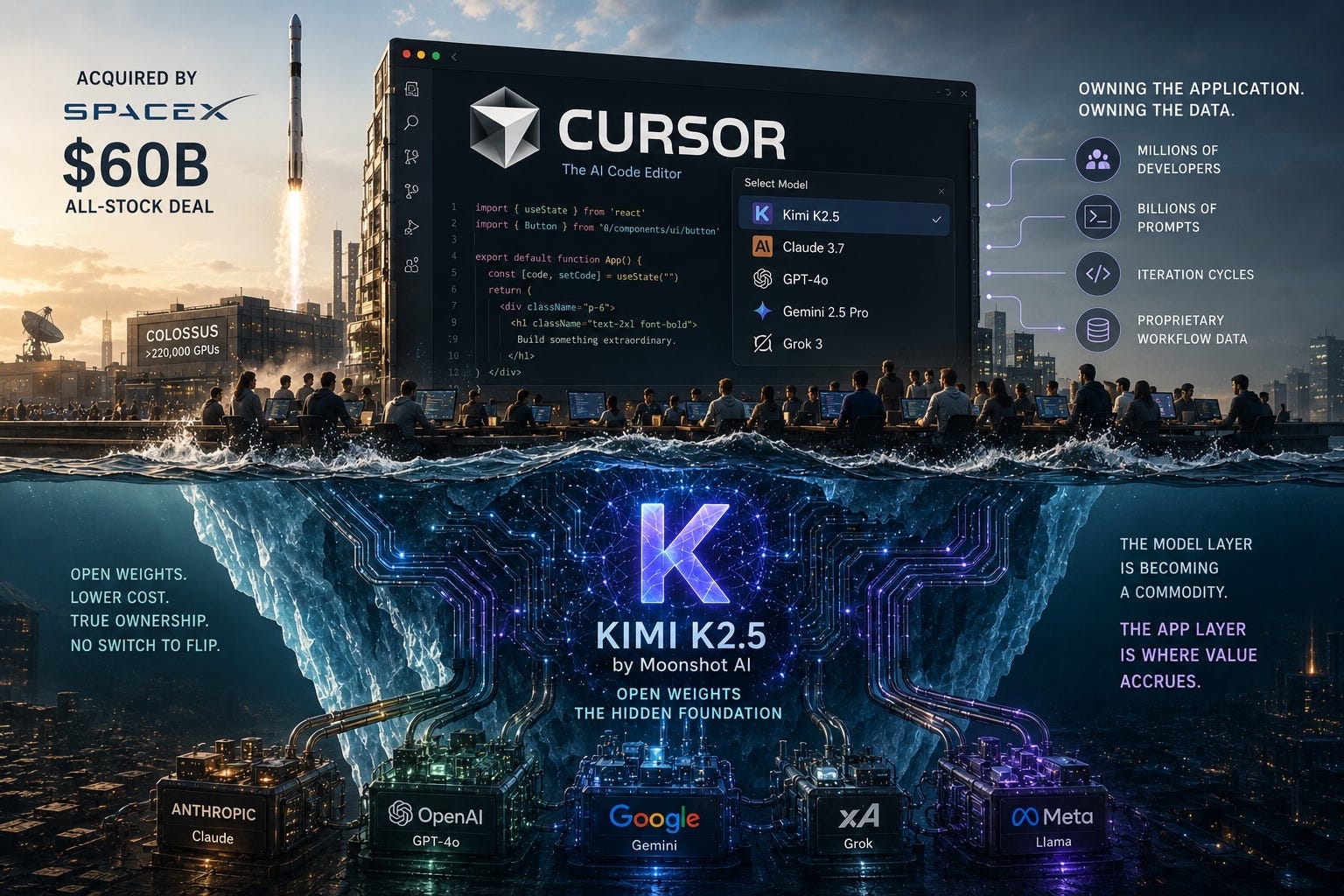
The neutral place to use everything
The neutrality is the strategy. By being the best place to use every frontier model, Cursor made itself the layer between developers and the labs. The labs supply the intelligence; Cursor owns the relationship, the workflow, and the part that matters most, the data: which model wins which task, what developers do all day, where the code goes after the suggestion lands.
That’s the old aggregation move. Own demand and your suppliers become interchangeable. When a customer can swap the model under the hood without changing how they work, the model is a commodity and the workflow is the moat (FourWeekMBA). Cursor built the workflow. The models became things it shopped for.
Why Cursor built its own model
Reselling other people’s models is brutal economics, and it gets worse as the models get better. In June 2025 Cursor overhauled its $20 Pro plan, swapping a fixed allotment of fast requests for usage metered at API rates. Heavy users burned through it in days and got surprise bills, some reportedly hundreds of dollars in a week, and CEO Michael Truell apologized and refunded the gap (TechCrunch). The cause was arithmetic, not greed: Claude Opus runs about $15 per million input tokens and $75 per million output, and a flat fee can’t survive customers leaning on that all day.
So Cursor paid a toll on every keystroke, set by the same labs it competed with, near-retail for models its biggest supplier could serve at cost. By one report it once made up something like half of Anthropic’s revenue (36Kr): its largest customer and its most exposed rival at once. When Anthropic’s own coding tool took off, and after Anthropic had reportedly cut another rival off, Cursor’s leadership called what staff described as a state of emergency in early 2026 and pushed to build its own model (Trending Topics).
The answer was Composer, Cursor’s in-house model, set as a default inside the product. The logic is simple. If you already own the user, the next thing to own is the model, so you stop renting the one input your whole business runs on.
It climbed up on Chinese weights
There’s a catch. Training a frontier model from scratch costs more than even a fast-growing app can justify. Cursor’s way up was open weights. Composer is built on Kimi K2.5, an open model from the Chinese lab Moonshot AI, which Cursor said in its own engineering blog (Cursor) and confirmed when pressed (TechCrunch). Its framing is that the open model was a starting point and most of the work since is its own. I wrote separately about why that open layer exists. That’s the story from below; this is the story from above.
Put them together and the shape is clear. An application used cheap open weights to climb into the model layer, so it could stop paying the closed labs above it. The model stopped being a destination and became a rung.
What $60 billion actually bought
It’s tempting to read $60 billion as the price of a very good text editor. The deal language points elsewhere. SpaceX called software development a strategically important use case because it throws off structured, verifiable data and constant feedback, and said Cursor’s workflows capture exactly that: the prompts, the iteration cycles, the architecture decisions developers make all day (SpaceX). Add a huge base of developers and the Colossus cluster’s 220,000-plus GPUs, and the two have been jointly training a model for months (AI Magazine).
So the buyer paid for distribution, a data flywheel, and a post-training team. The editor is what collects the data, and the data is what makes the next model better.
SpaceX isn’t alone. Meta paid about $2 billion for Manus, an AI-agent startup with Chinese roots, in December 2025 (CNBC). The giants are all reaching for the same prize: the application closest to the work and the data it throws off. The model is the part they can buy, rent, or copy. The application and its data are the part they have to own.
The week the governments showed up
The Cursor deal didn’t happen in a vacuum. In the same week it was signed, two governments reached into the stack and reminded everyone who else gets a vote.
On June 11, Meta started tearing its Manus deal apart. Beijing had ordered it unwound on national-security and tech-transfer grounds, and Meta began cutting Manus off from its systems (Tom’s Hardware). A $2 billion deal for an app, killed by a state that didn’t want the talent and data leaving the country.
A day later, on June 12, Washington did its own version. It ordered Anthropic to disable its two most powerful models, Fable 5 and Mythos 5, for every foreign national, citing a jailbreak. Anthropic switched both off worldwide to comply, then said it disagreed, warning that recalling a model “deployed to hundreds of millions of people” over a narrow flaw would “essentially halt all new model deployments” (TIME, Anthropic).
Sit with that. A model you rent can be recalled by someone else’s government overnight, with your product still wired to it. An app reselling it goes dark on an order it had no part in. Own your model, and especially open weights you can hold, and there’s no switch for a regulator to flip. The recall is the most expensive argument yet for Cursor’s strategy.
The squeeze
Now look at the labs in the middle. They’re pressed from both sides. From below, open weights out of China keep commoditizing the base model, so the floor under “good enough” rises and the price falls. From above, the applications own the customer and the data and are climbing down into the model layer themselves. OpenAI, Anthropic, and Google still make the strongest models in the world. They’re learning that making the strongest model is no longer the same as owning the most valuable position. And now a third party is in the room: the state.
This is the part I’d underline for anyone building, anywhere. The durable assets are the application, the proprietary data loop it runs, and weights you actually possess. The model is becoming an input you rent, the rent is falling, and the rental can be cancelled by people who aren’t even in the deal.
The honest counter
I don’t want to oversell this. The best closed frontier model still wins the hardest tasks, which is why Cursor still ships that dropdown and why I still reach for the strongest model on the problems that actually scare me. The labs keep real pricing power on the frontier even as the floor commoditizes, and they can move up-stack too: Anthropic’s own coding tool already undercuts what Cursor can charge, the same game in reverse. The squeeze is a direction, not a verdict.
What I’m watching
The new owner’s model. Cursor now belongs to SpaceX, whose sibling xAI makes Grok. Watch whether Cursor’s default quietly tilts toward Grok and away from the labs it used to resell. The neutral aggregator just got an owner with a model to sell.
Default share. Whether Composer, or its xAI successor, becomes the model most Cursor sessions actually use. If the share that never touches an outside lab crosses half, the toll route is broken for good.
Labs reclaiming the user. Whether OpenAI and Anthropic push their own coding surfaces to own the developer directly. Anthropic’s already costs less than Cursor can match; watch whether that becomes the strategy, not a side project.
Governments as dealmakers. Whether more cross-border app deals get unwound the way Beijing killed Meta-Manus, and whether model recalls like Anthropic’s become routine. If they do, weights you can hold beat an API a regulator can switch off.
The dropdown that lets me run any model was the whole strategy in miniature. Cursor turned the frontier labs into interchangeable suppliers, used cheap open weights to become one of them, and just sold the result for $60 billion. The model is the input now. The application is the business. And in a single week in June, a $60 billion deal and two governments all moved on the same stack.
This reminds me of the Hamilton line: “No one else was in the room where it happened.”
We just experience the outcome, not the system behind it.
“Laws, like sausages, cease to inspire respect in proportion as we know how they are made.”
The piece made me think about how quickly the model becomes infrastructure once the product is good enough. Most users (including me) don’t really care what model or system is underneath, just whether the tool fits into their workflow and works.
If that’s where things are headed, does asking “which model is this?” eventually feel as irrelevant as asking what powers the plumbing, instead of just using the tap?
And on Cursor specifically, is this shift just more visible in coding tools because dev workflows are unusually sticky, or is this the early shape of a broader “app eats model” world?